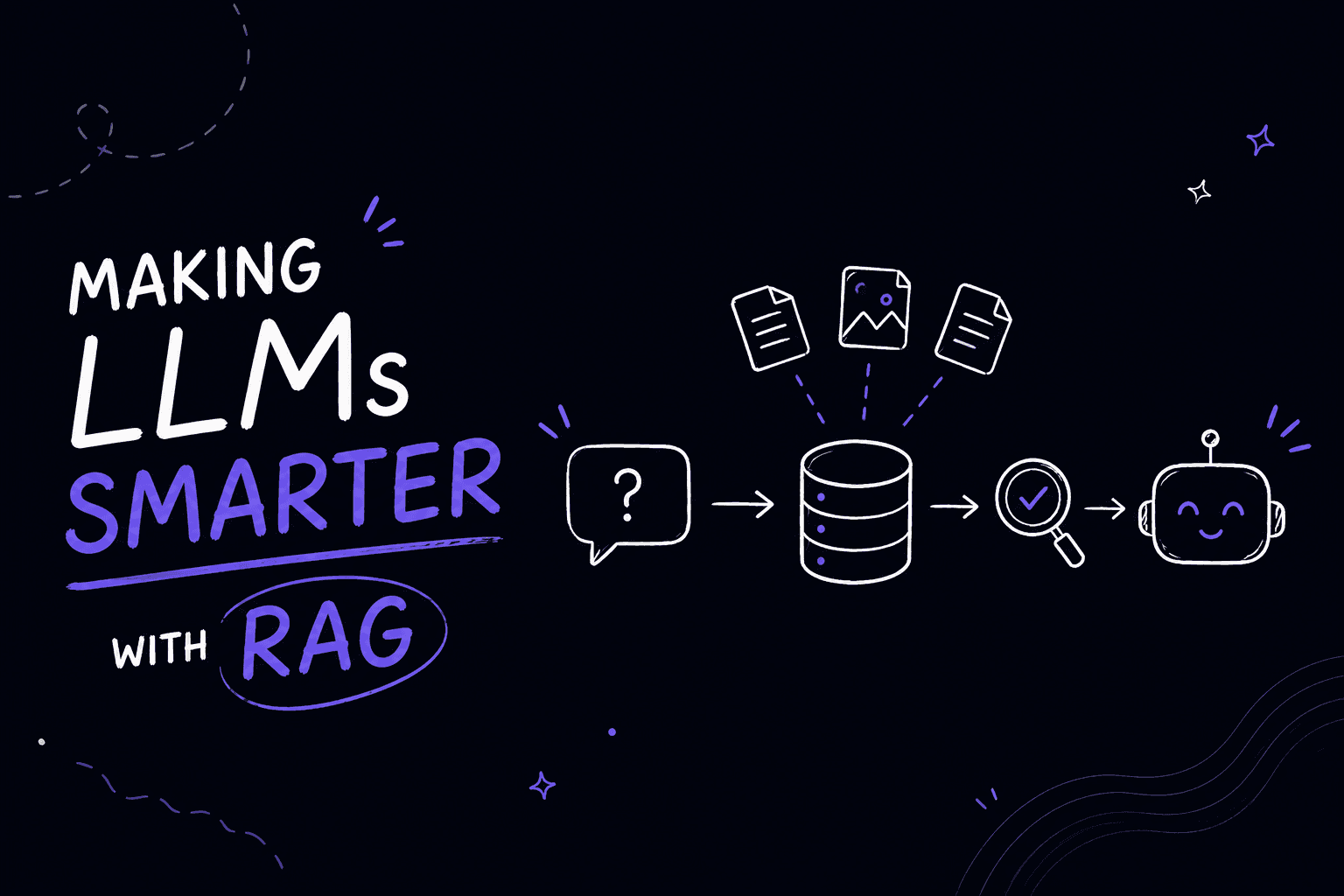
Making LLMs Smarter with RAG
RAG (Retrieval-Augmented Generation) is a process that makes LLMs significantly smarter and more useful by providing them with external data as context. This context can be anything from publicly available internet data to a company's private, internal information.
However, raw data is massive. If you try to feed it all in at once, it will overflow an LLM's context window in seconds. Instead of directly providing all this raw data to the model, we first break it down and store it in a special system known as a vector database.
The Problem with Traditional Databases
But what exactly is a vector database, and why do we need one?
Traditionally, we used relational databases to store unstructured information (like an image saved as binary data). We would attach metadata, labels, or tags to help retrieve it later. The problem is that searches are strictly bound to those exact tags. You cannot perform a semantic search like typing "A yellow flower" to magically find images of yellow flowers unless someone specifically typed that exact label beforehand.
How Vector Databases Understand Meaning
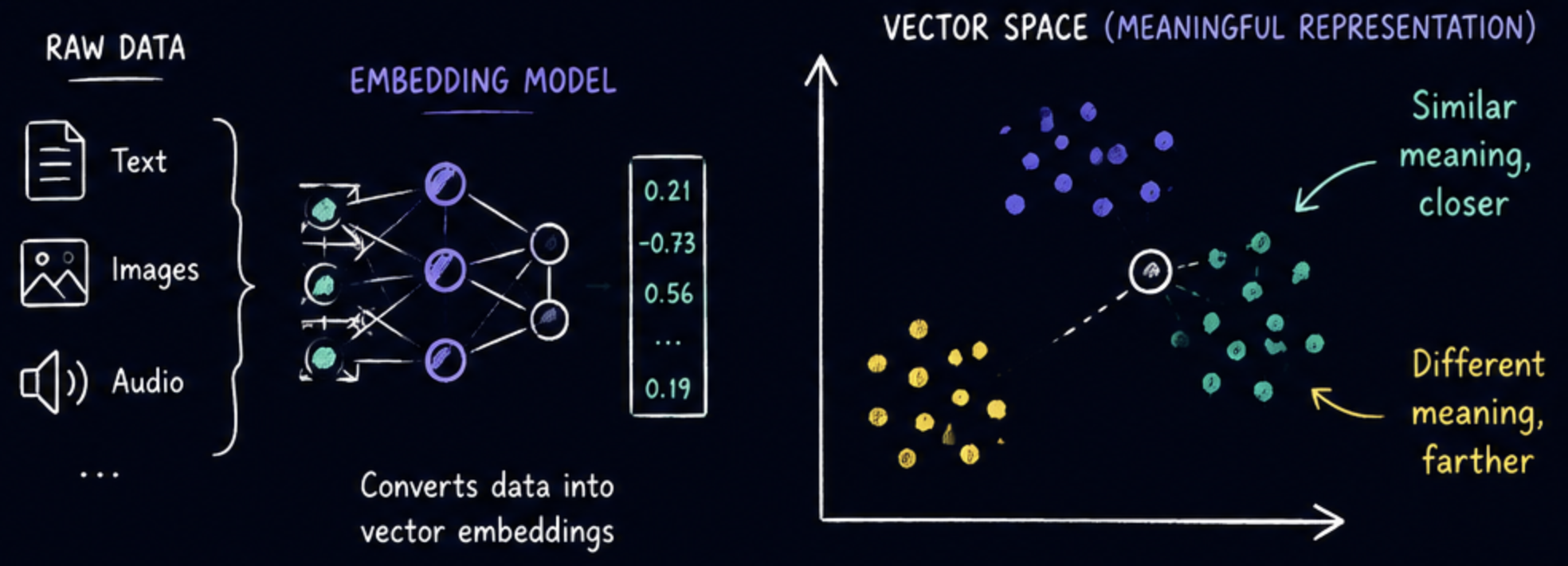
To solve this, vector databases step in. They are designed to store unstructured, multidimensional data by converting it into a mathematical format that AI understands perfectly: vector embeddings.
A special embedding model handles this conversion. When unstructured data passes through the model's layers, it extracts core features like the shapes in an image or the deep meaning of a text string and turns them into an array of numbers.
These embeddings capture the actual semantic nature of the data. In a vector space, similar concepts are placed very close together, while dissimilar ones are pushed far apart.
The Retrieval Workflow
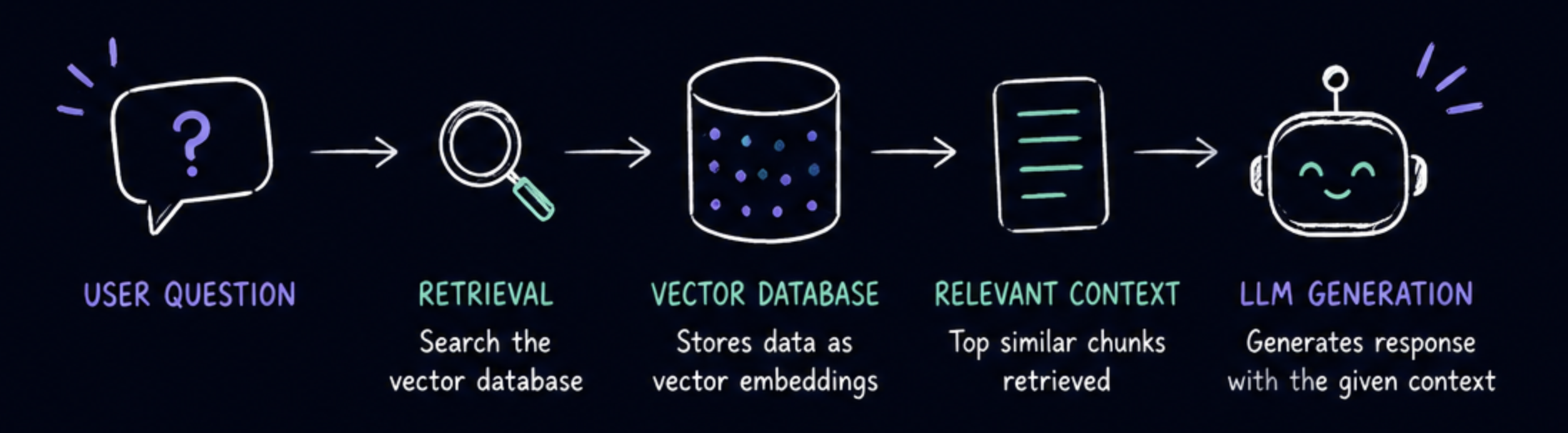
Because of this spatial layout, the system can easily perform a "similarity search." Here is how the flow actually works:
1. A user asks the LLM a question.
2. The prompt passes through the vector DB.
3. The database retrieves only the specific chunks of data that mathematically match the meaning of the user's prompt.
4. This retrieved data is fed to the LLM as a highly relevant context window.
5. Finally, the LLM generates a response in its own words, prioritizing the user's exact query.
The Speed Problem and the ANN Solution
While this architecture is brilliant, it introduces a new challenge: speed. Vector databases store data across thousands of dimensions, and a single database can contain millions of vectors. Comparing a user's input against every single dimension of every single vector would be tremendously slow.
To fix this bottleneck, vector indexing methods are used. Specifically, the system uses ANN (Approximate Nearest Neighbor) algorithms. Instead of calculating the exact mathematical distance for everything, ANN finds the closest semantic space by trading off a tiny bit of absolute accuracy in exchange for a massive, necessary increase in retrieval speed.Here is your blog post, completely restructured for a smooth, logical flow. I removed the repetitive explanations, fixed the starting phrase, and organized the concepts so they build on each other perfectly while keeping your explanatory tone.