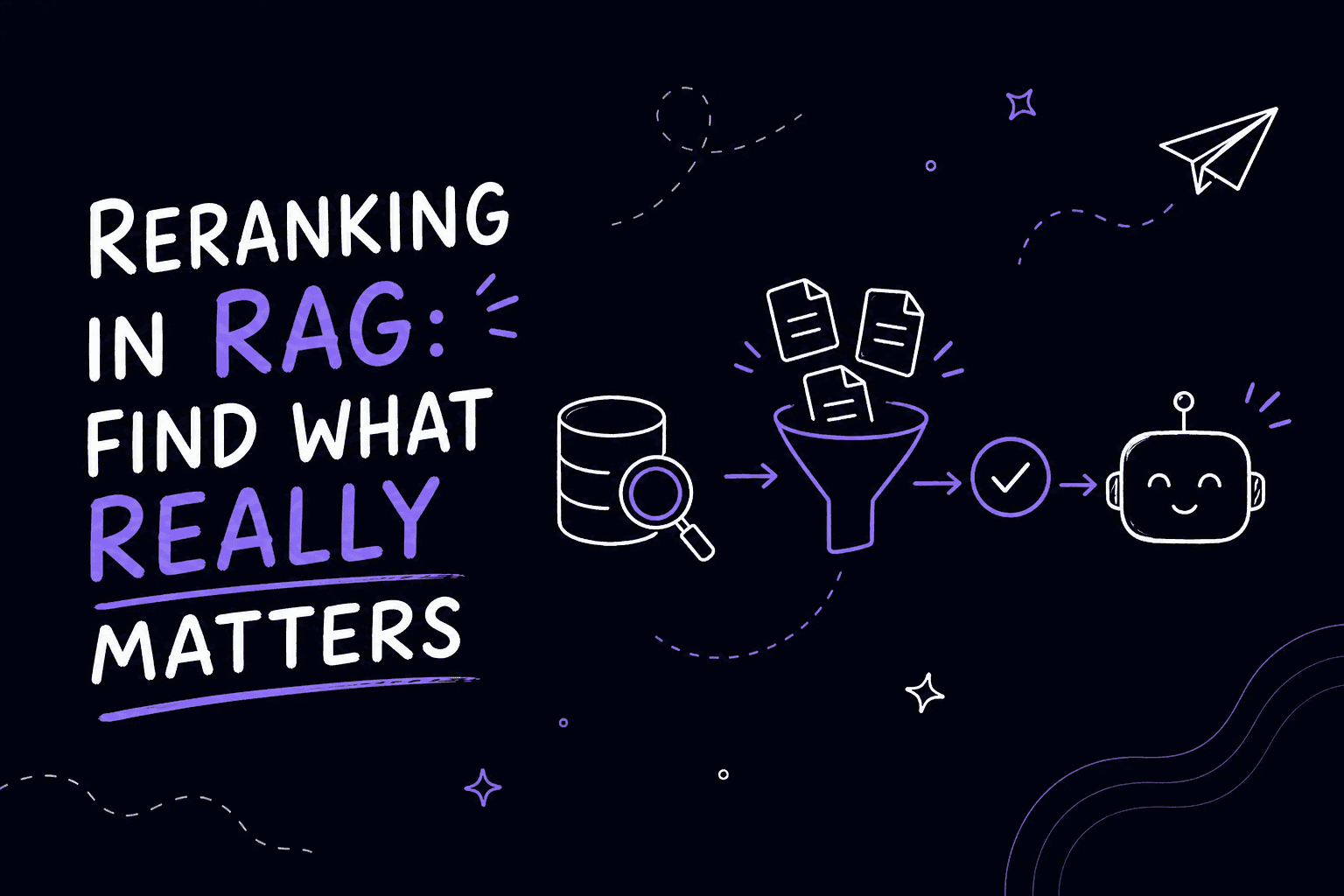
If you have built a basic RAG architecture, you have probably noticed a frustrating problem. Sometimes the vector database returns documents that contain the right keywords, but completely miss the actual meaning of the user's request.
For example, you ask, "How do I open a bank account?" and the database returns a document about "The muddy bank of a river."
Why does this happen? Because standard vector search is incredibly fast, but it is fundamentally kind of "dumb." To fix this, modern RAG architectures use a post-retrieval technique called Reranking.
Here is exactly what Reranking is, how it works at a high level, and why your RAG pipeline absolutely needs it.
The Problem: Bi-Encoders (Fast but "Dumb" Search)
To understand Reranking, you first need to understand how your vector database actually searches.
When you embed documents into a vector DB (like Pinecone or pgvector), you are using a model known as a Bi-encoder. A Bi-encoder processes the user's query and the stored document completely separately from each other.
It turns the Document into an array of numbers.
It turns the Query into an array of numbers.
It uses a basic math formula to measure the distance between those two arrays.
Because it calculates them separately, the model never actually gets to see how the words in the query interact with the words in the document. It is just blindly comparing two coordinates in space. This makes it lightning fast (it can search millions of documents in milliseconds), but it lacks deep comprehension.
The Solution: Cross-Encoders (Slow but "Smart" Reranking)
Reranking introduces a second, much smarter model into the pipeline called a Cross-encoder (popularized by models like Cohere Rerank).
Instead of processing the query and document separately, a Cross-encoder feeds them into the neural network at the exact same time. Because they are processed together, the AI can look at every single word in the query and deeply analyze how it connects to every single word in the document.
It deeply understands the context, the nuance, and the semantic relationships. It then assigns a highly accurate "Relevance Score" to the document.
If Cross-Encoders are so smart, why not use them for everything?
Speed. Because a Cross-encoder has to deeply read the query and the document simultaneously, you cannot pre-compute the math. If you had 1 million documents, comparing a user's query against all 1 million documents using a Cross-encoder would take hours.
The Two-Stage Retrieval Pipeline
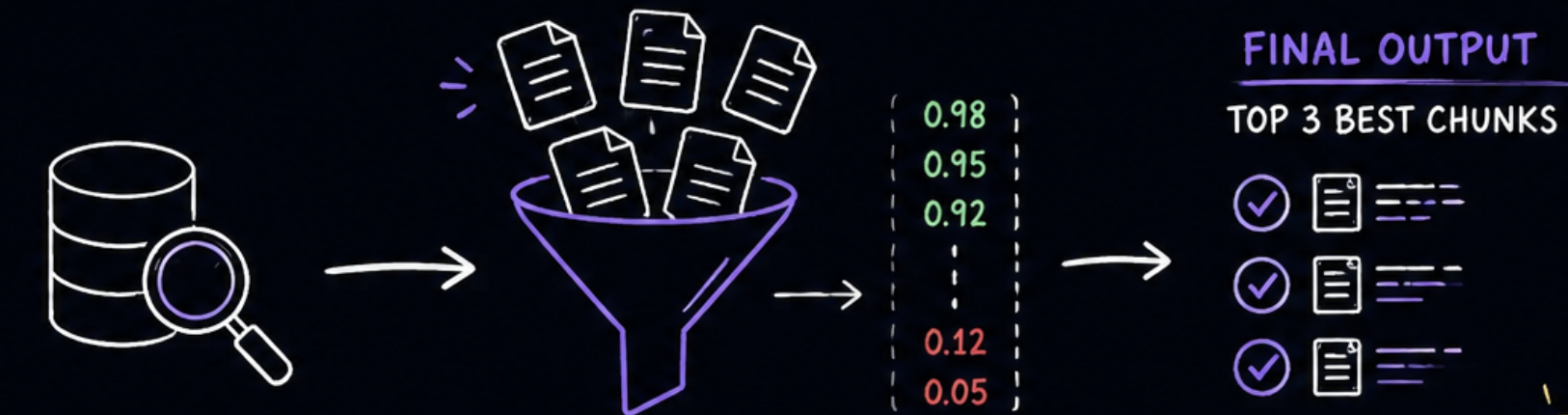
To get the best of both worlds the speed of a Bi-encoder and the brilliant accuracy of a Cross-encoder we combine them into a Two-Stage Pipeline. This is the industry standard for enterprise RAG:
Stage 1: The Wide Net (Vector Search)
The user asks a question.
Your fast Vector Database scans 1 million documents and returns the Top 50 chunks. (Some of these are great, but some are just terrible keyword matches).
Stage 2: The Judge (Reranking)
You take those 50 chunks and pass them to your Reranker model, along with the user's original query.
The Reranker deeply reads all 50 chunks, calculates a precise relevance score for each, and re-orders the list from best to worst.
You discard the bottom 47, and only send the Top 3 absolute best, fact-checked chunks to your final LLM.
By adding a Reranker to your RAG pipeline, you dramatically reduce hallucinations because you guarantee that the final LLM is only ever reading the highest-quality, most contextually accurate data available.